Summary: This blog explains how voice AI helps U.S. restaurants manage rush-hour calls, reservations, takeout inquiries, and routine customer questions. It explores the differences between traditional phone systems and AI voice agents, explains how automation can reduce communication delays, and offers practical advice on choosing and implementing a solution while keeping staff focused on guest service.
Friday evening. The dining room is filling up, customers are waiting to be seated, and the kitchen is working through a growing list of orders. Then the phone starts ringing. Someone wants to book a table, another caller is asking about takeout, and a third wants to know how long the wait will be.
Your host is already busy. A server is helping a customer. Nobody gets to the phone in time.
This situation is familiar to many restaurant owners across the United States. The problem isn't always a lack of staff. Sometimes, there are simply too many things happening at once.
That's where voice AI for restaurants can help. It answers incoming calls, handles routine questions, supports reservation and ordering workflows, and gives staff more time to focus on guests in front of them.
In this guide, we'll look at how restaurant voice AI works, where it can reduce delays, and what restaurant operators should consider before adopting it in 2026.
Why Rush Hour Is So Challenging for Restaurants
Restaurant rush hours put several parts of the business under pressure at the same time. During weekday lunch, dinner service, weekends, and holidays, staff must manage customer requests without slowing down the overall experience.
A ringing phone might seem like a small issue. But when nobody answers, a potential reservation or takeout order can disappear.
Too Many Calls and Not Enough Staff
During busy periods, hosts are seating guests, servers are taking orders, and managers are dealing with unexpected problems. Answering the phone becomes another task competing for their attention.
A December 2025 report from Maple, based on more than 1.2 million calls across over 1,000 restaurant and local business locations, found that restaurants in its dataset missed 33% of incoming calls during peak service hours.
The findings reflect that company's customer base, rather than every U.S. restaurant, but they illustrate the problem. (Source: Maple's restaurant call analysis)
Long Wait Times and Missed Reservations
Customers don't always want to wait for someone to answer a phone. If a restaurant doesn't respond, they may call another place or choose to book online elsewhere.
The same problem affects guests who are already waiting for a table. Staff may be too occupied to answer questions about estimated wait times or reservation changes.
Takeout Orders Competing With In-Person Service
Takeout calls often arrive when the kitchen is already busy. Staff must listen to the order, confirm details, answer questions about the menu, and communicate pickup times.
If this process interrupts other tasks, it can create additional pressure on the team.
How Small Delays Affect the Customer Experience
A missed call, an unanswered question, or an unclear pickup time might seem minor on its own. Over a busy shift, these small issues can add up.
The goal isn't to make every interaction faster at any cost. It's to make sure customers receive accurate information and staff can give each guest the attention they need.
How Voice AI Helps Restaurants Handle Rush Hour
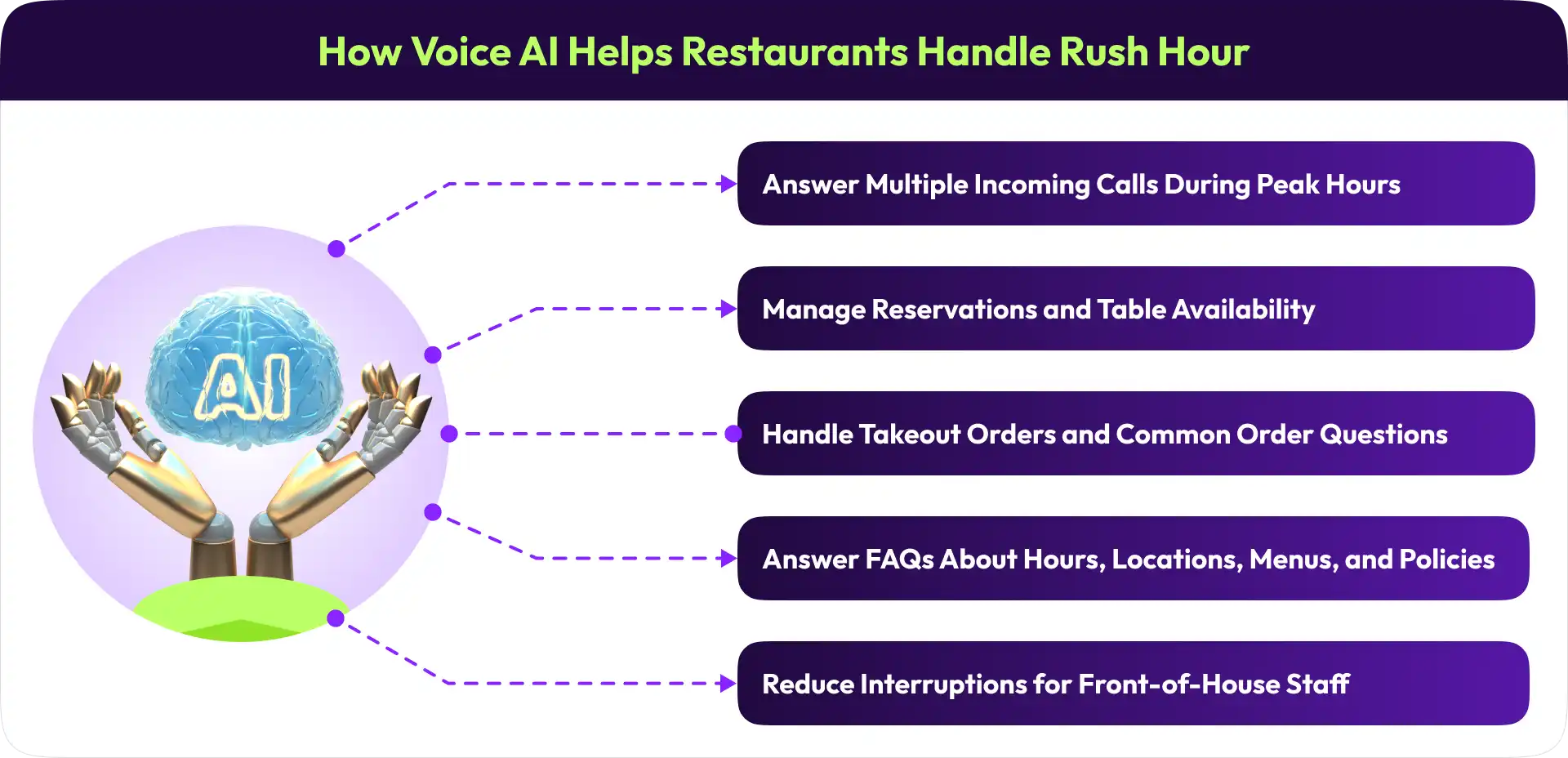
Voice AI can help manage the communication problems that occur when restaurants are busiest. Its value comes from handling specific tasks reliably, not from magically removing every operational bottleneck.
Answer Multiple Incoming Calls During Peak Hours
A busy restaurant may receive several calls close together. A human host can only handle so many conversations at once, especially while greeting customers and coordinating tables.
A properly configured voice AI system can handle multiple calls according to its available capacity and configuration. It can greet callers, understand what they need, and respond without requiring a staff member to pick up every call.
Consider a neighborhood restaurant during the Friday dinner rush. One caller wants directions, another asks about reservations, and a third wants to know whether takeout is available. The AI agent can handle supported requests while the front-of-house team continues serving guests.
That doesn't mean every call should stay with AI. Requests involving complaints, unusual arrangements, or sensitive situations may need a human handoff.
Manage Reservations and Table Availability
Reservation requests can be difficult to manage when the host stand is busy. Voice AI can help by collecting details such as party size, preferred date, time, and contact information.
When connected to a compatible reservation system, it may also check availability, create bookings, and handle supported changes or cancellations.
For example, a customer calling a restaurant in Chicago could ask for a table for six on Saturday evening. The agent can check available slots through the connected system and offer suitable options.
The integration matters here. Without access to live availability, an AI agent shouldn't promise that a table is available or confirm a booking it hasn't actually created.
Restaurants should also distinguish between reservations and walk-in waitlists. These are different workflows, and waitlist updates require accurate information about seating and table turnover.
Handle Takeout Orders and Common Order Questions
Takeout orders create another stream of phone activity during peak periods. Voice AI can help capture order details, clarify supported options, and communicate pickup information.
Depending on the restaurant's setup, it may collect items, quantities, modifications, and customer details before passing the order into the relevant ordering or POS system.
For example, a customer calling a pizza restaurant might ask for two pizzas with different toppings and a specific pickup time. The agent can confirm the details and follow the configured ordering process.
However, the restaurant must verify that its AI system supports the menu, customizations, pricing, and required integrations. If the system cannot reliably process an unusual request, it should transfer the call or direct the customer to another ordering channel.
Answer FAQs About Hours, Locations, Menus, and Policies
Many restaurant calls involve questions that don't require a manager or server. Customers may want to know:
- What time does the kitchen close?
- Do you have vegetarian options?
- Is parking available?
- Do you accept large-party reservations?
- Can I bring my own birthday cake?
- Do you offer takeout on Sundays?
A voice AI agent can answer these questions using restaurant-approved information. This is particularly useful for restaurants with several locations. Each location may have different opening hours, menus, or booking policies, so the information must be configured correctly.
When an answer isn't available, or a question requires judgment, the system should acknowledge the limitation rather than invent a response.
Reduce Interruptions for Front-of-House Staff
Perhaps the most useful benefit is the time staff get back. When an AI agent handles routine calls, hosts can focus on seating guests, servers can concentrate on orders, and managers can deal with operational issues instead of answering the same questions repeatedly.
That doesn't mean the workload disappears entirely. Staff may still need to review unusual requests, resolve order problems, and help customers who prefer speaking with a person.
The idea is to remove avoidable interruptions, not remove the human side of restaurant service.
Can Voice AI Actually Reduce Restaurant Wait Times?
Yes, but it helps to understand which wait times you're trying to reduce. Voice AI is best suited to delays caused by communication, unanswered calls, and manual handling of routine requests. It cannot automatically solve every queue or kitchen bottleneck.
Reducing Phone Wait Times
If a voice AI agent can answer an incoming call immediately, customers may not need to wait for a host to become available.
This can make it easier to get information, request a reservation, or begin an ordering process during busy periods.
Keeping Reservation and Takeout Requests Moving
When connected to the relevant systems, voice AI can help process reservations and supported orders without requiring staff to enter every detail manually.
Accurate confirmations also reduce confusion about booking times, order details, and pickup arrangements.
Helping Staff Focus on Guests Already in the Restaurant
When routine calls no longer interrupt employees as often, the team can spend more time with guests who are already seated or waiting.
Still, AI won't make a full dining room empty faster or reduce cooking time by itself. Actual seating delays depend on table availability, party size, turnover, staffing, and other operational factors.
Restaurants should measure phone response times, booking completion, missed calls, and guest feedback separately from physical seating and kitchen wait times. That gives a more realistic picture of whether the technology is helping.
Voice AI vs. Traditional Restaurant Phone Systems
Traditional phone systems remain useful for basic communication. Voice AI adds conversational handling and, when integrated correctly, the ability to complete supported tasks.
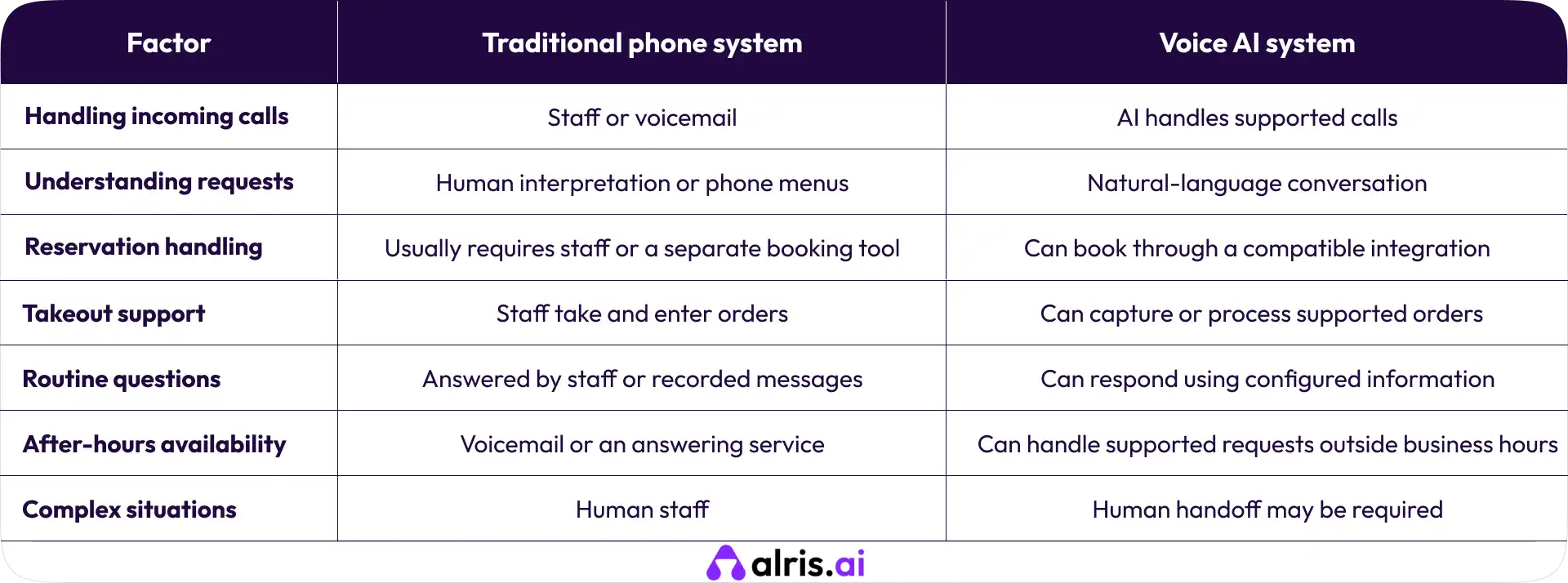
A traditional phone system may be enough for a small restaurant with low call volume. Voice AI becomes more attractive when repeated calls interrupt service, after-hours inquiries matter, or the restaurant needs a more consistent way to manage guest communication.
The right choice depends on call volume, operational needs, budget, and available integrations.
How to Choose the Right Voice AI System for Your Restaurant
Not every restaurant needs the same features. Before choosing a voice AI solution, identify the problems you want it to solve and evaluate its capabilities against your actual workflows.
Check Reservation and POS Integrations
If you want AI to book tables or process takeout orders, check whether it integrates with your existing reservation platform, POS, or ordering software.
Ask whether the connection supports live availability, order submission, cancellations, and updates. Don't assume that a vendor supports every feature simply because it lists an integration.
Look for Accurate Call Handling and Human Handoffs
Test how the system responds to background noise, different accents, unusual menu requests, and customers who change their minds.
It should recognize when it doesn't have enough information and provide a clear route to a staff member. A confident but incorrect answer can create more work than an unanswered call.
Review Pricing, Call Capacity, and Reporting
Compare subscription fees, usage charges, setup costs, and integration expenses. Check how many simultaneous calls the system can handle and whether that capacity fits your busiest periods.
Reporting should help you understand call volume, missed opportunities, common questions, completed bookings, and calls transferred to staff.
Consider Privacy, Recording, and Data Handling
Restaurant calls may contain customer names, phone numbers, booking details, and payment-related information.
Ask how recordings and transcripts are stored, who can access them, how long they're retained, and whether the vendor supports your applicable privacy and security requirements. Review relevant federal and state call-recording laws before enabling recording or transcription.
Is Voice AI Worth It for Restaurants?
Voice AI can be worth considering if your restaurant receives frequent calls during service, struggles to answer every inquiry, or spends too much staff time managing routine requests.
It may be particularly useful for full-service restaurants, takeout-focused businesses, and multi-location groups with recurring communication needs.
However, the business case depends on more than the number of calls answered. Consider the value of completed reservations and orders, the time saved by employees, implementation costs, and the quality of the customer experience.
Start by measuring your existing performance. If missed calls and repeated interruptions are persistent problems, a limited pilot can help determine whether voice AI provides enough value to justify the investment.
How Restaurants Can Get Started With Voice AI in 2026
You don't need to automate every restaurant workflow at once. A smaller rollout can help you identify what works before expanding.
Identify peak-hour problems. Review missed calls, repeated questions, booking requests, and interruptions during lunch and dinner.
Choose one workflow. Start with call answering, FAQs, reservations, or takeout inquiries. Connect the necessary systems. Make sure the AI can access accurate information and complete the intended tasks.
Test real-world conversations. Include unusual requests, unavailable booking slots, menu modifications, and situations requiring staff.
Measure the results. Compare call answer rates, completed bookings, transfers, customer feedback, and staff workload before and after deployment.
Final Thoughts
Rush hour will always bring pressure to restaurant operations. Tables need to turn, orders need to reach the kitchen, and customers expect timely answers. The phone shouldn't make an already busy shift harder than it needs to be.
Voice AI gives restaurants another way to manage incoming calls, handle routine requests, and support reservation and ordering workflows. When configured correctly, it can reduce communication delays and free employees to focus on in-person service.
The best starting point is simple: identify where your restaurant loses time, choose one workflow to improve, and measure the results.
Want to explore how voice AI could help your restaurant handle busy hours? Discover Alris AI for Restaurants.
Frequently Asked Questions About Restaurant Voice AI
1. Can voice AI answer restaurant calls during rush hour?
Yes. A properly configured voice AI agent can answer supported calls during busy periods and handle multiple conversations within its capacity. It can respond to common questions, collect booking details, and route requests that need staff attention.
2. Can AI manage restaurant reservations and waitlists?
It can manage supported reservation tasks when connected to a compatible booking system. Waitlist management may also be possible, but it requires access to accurate availability and waitlist data. Not every voice AI system supports both workflows.
3. Can voice AI take restaurant orders over the phone?
Yes, some systems can collect and submit takeout orders. The exact capability depends on the AI configuration and integration with the restaurant's menu, ordering platform, and POS. Restaurants should test customizations, prices, and order confirmations before launch.
4. Does restaurant voice AI replace front-of-house staff?
No, it doesn't have to. Many restaurants use voice AI to handle routine phone tasks while employees focus on hospitality, seating, food service, and complex customer requests. The goal is to support the team, not eliminate human interaction.
5. Can voice AI integrate with existing restaurant software?
Some systems integrate with reservation platforms, POS software, calendars, and customer management tools. However, integration availability and functionality vary. Confirm whether the connection supports the specific actions you need, such as live booking, order submission, or reservation changes.