Insurance operations are under pressure from every side. Customers expect faster responses, clearer communication, and real-time updates, while insurers are trying to manage rising costs, complex workflows, and growing operational volume. Yet in many companies, the day-to-day reality still depends on manual forms, repeated document checks, and disconnected systems.
This is exactly why insurance process automation is becoming more important. It helps insurers remove unnecessary delays, reduce repetitive work, and build workflows that move faster with less manual effort. And when AI is added into the process, automation becomes more than rule-following. It becomes capable of reading documents, supporting decisions, and routing tasks intelligently.
In this blog, we will look at how insurance process automation works, where it creates the most value, and how it helps insurers reduce costs while improving customer experience across the full insurance journey.
Why Insurance Operations Need a Smarter, More Efficient Approach Today
A lot of insurance operations still feel stuck in older ways of working. Manual forms, back-and-forth emails, duplicate checks, and repeated follow-ups may still get the job done, but they make every process slower than it needs to be.
That slowness is becoming harder to tolerate. Customers want answers quickly. They want updates without having to ask. And they do not want to wait days just to understand the status of a claim or policy request.
At the same time, insurers are facing internal pressure as well. Operational costs are rising. Teams are stretched thin. Scaling becomes harder when growth depends on adding more people instead of improving how work gets done.
Insurance process automation addresses this by removing friction from routine workflows. It is not about replacing people. It is about helping processes move faster, smoother, and with fewer avoidable delays.
What Is Insurance Process Automation With AI and How It Works
Insurance process automation means using digital systems to handle repetitive insurance tasks automatically instead of relying on manual effort for every step.
Basic automation usually follows fixed rules. For example, if a document is complete, it moves to the next stage. This is useful, but it can only operate within predefined conditions.
AI-driven automation takes this further. AI can read documents, extract important data, understand context, and support decisions in ways basic automation cannot. Instead of someone manually reviewing every claim document, AI can process the file, pull key details, validate information, and move the workflow forward automatically.
That is the real difference. Insurance automation becomes intelligent when it can do more than just follow rules. It can help workflows adapt, respond, and move with far less manual coordination.
Why Insurance Operations Still Feel Slow and Disconnected
If you work in insurance operations, you have probably seen the same delays again and again. Manual data entry consumes time. Documents sit across emails, folders, and disconnected systems. Claims pass through multiple approvals. Even simple cases often wait for human review.
A bigger issue is that systems often do not communicate well with each other. As a result, people step in constantly to bridge gaps, transfer information, and keep work moving.
All of this creates slower operations, frustrated teams, and longer wait times for customers. These are exactly the kinds of problems that process automation in insurance is built to solve.
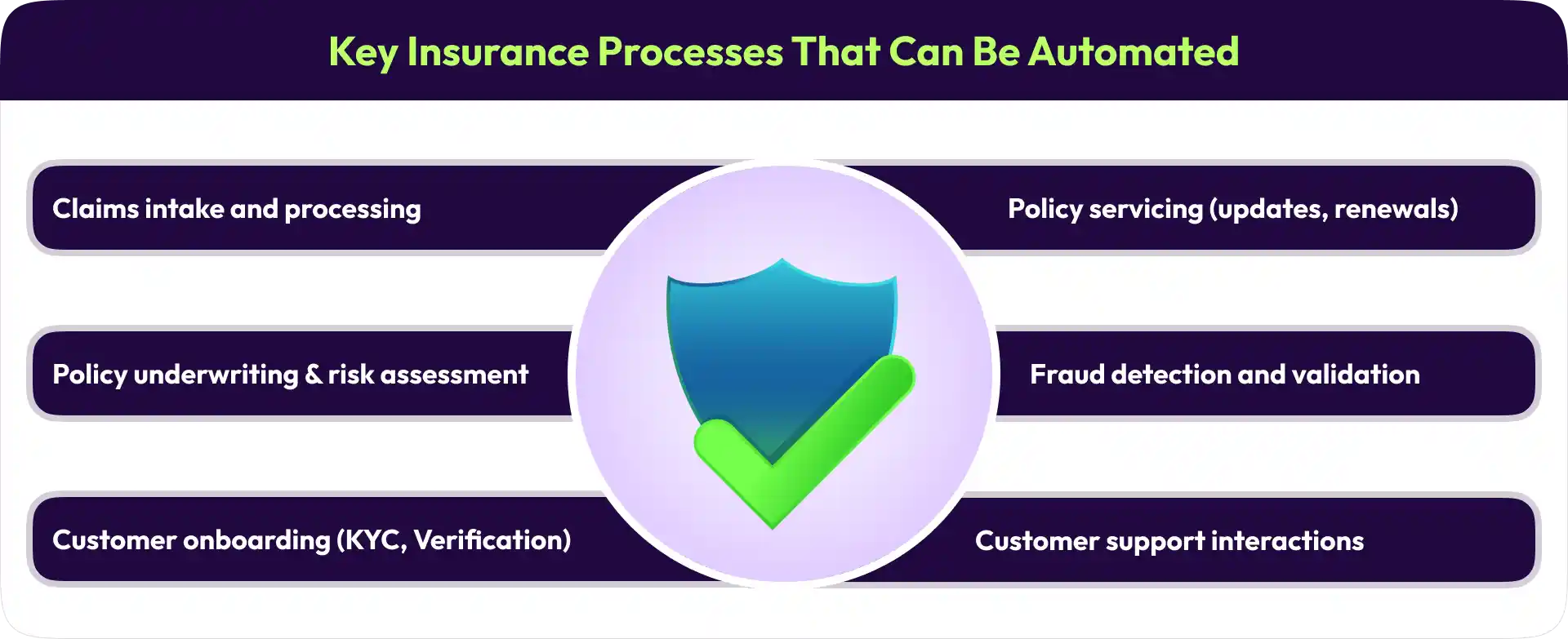
Key Insurance Processes That Can Be Automated
Uploaded from Computer
Automation in insurance is not limited to one part of the workflow. It can improve operations across the full policy and claims lifecycle.
Claims intake and processing, from document collection to validation and approvals
Policy underwriting and risk assessment with AI-supported analysis
Customer onboarding, including KYC and document verification
Policy servicing such as updates, renewals, and routine changes
Fraud detection and validation through pattern recognition
Customer support interactions such as reminders, claim updates, and status requests
What makes this valuable is that these tasks do not have to stay isolated. They can be connected into one continuous workflow that moves across systems and teams without repeated handoffs.
How AI Automates the Insurance Workflow Step by Step
A typical insurance workflow involves multiple stages, and each stage often introduces waiting time. AI-powered insurance process automation reduces those gaps and turns disconnected steps into a more continuous flow.
1. Data Capture From Multiple Sources
Insurance data can come from forms, emails, PDFs, uploaded documents, and even images. AI tools can capture this information automatically without requiring staff to enter it manually into each system.
2. Intelligent Document Processing
Insurance operations rely heavily on documents. AI can read these files, understand the context, and extract details such as policy numbers, claim amounts, dates, and other relevant fields. It may not be perfect in every case, but it removes most of the repetitive manual effort.
3. Validation and Decision Support
Once data is extracted, the system can run checks automatically. It can verify whether a policy is active, whether a claim matches coverage, and whether there are any red flags. AI can support these decisions directly or escalate exceptions that need review.
4. Automated Workflow Routing
Instead of relying on someone to assign each task manually, the workflow routes cases automatically. Simple claims can move ahead instantly, while complex ones are sent to the correct team without unnecessary back-and-forth.
5. Real-Time Communication and Updates
Customers no longer need to repeatedly ask for updates. Automated systems can send notifications when a claim is received, under review, approved, or requires more information. This creates a smoother and more transparent experience.
Insert via URL
Real-World Use Cases of Insurance Process Automation
The value of automation becomes clearer when you look at how it works in practice. Across the insurance industry, several use cases are already delivering measurable improvements.
Faster claim approvals for low-risk cases without waiting for manual review
Instant policy issuance after customer details and documents are verified
Automated claim status updates that reduce pressure on support teams
Fraud detection based on unusual patterns or mismatched claim data
AI-driven customer support for policy status, renewals, and claim tracking
Policy renewals and reminders triggered automatically at the right time
Customer onboarding and KYC handled in one connected flow
Internal workflow automation for approvals, escalations, and task assignment
Individually, these use cases improve specific operational tasks. Together, they reshape how insurance operations function every day.
How Insurance Process Automation Reduces Operational Costs
Cost savings from insurance operations automation often build gradually, but they become significant over time.
Reduced manual workload lowers the time spent on repetitive tasks
Higher processing capacity allows teams to handle more volume without proportionally increasing headcount
Fewer errors reduce rework, corrections, and operational waste
Faster turnaround times improve efficiency across large case volumes
Better use of human resources allows teams to focus on complex work and customer relationships
So automation does not just cut costs directly. It helps insurers use existing people and systems more intelligently, which becomes especially valuable as operations scale.
How Automation Improves Customer Experience
Customer experience in insurance has often been shaped by long wait times, too many follow-ups, and limited visibility into what is happening. Automation improves that experience in very practical ways.
Faster responses and resolutions for routine requests
Real-time visibility into claim and policy status
Less back-and-forth communication because data is captured correctly the first time
Consistent service across email, chat, portals, and other channels
More personalized interactions based on data and prior behavior
When customers feel informed instead of confused, their trust improves. Insurance automation is not only about speed. It is also about clarity, confidence, and control.
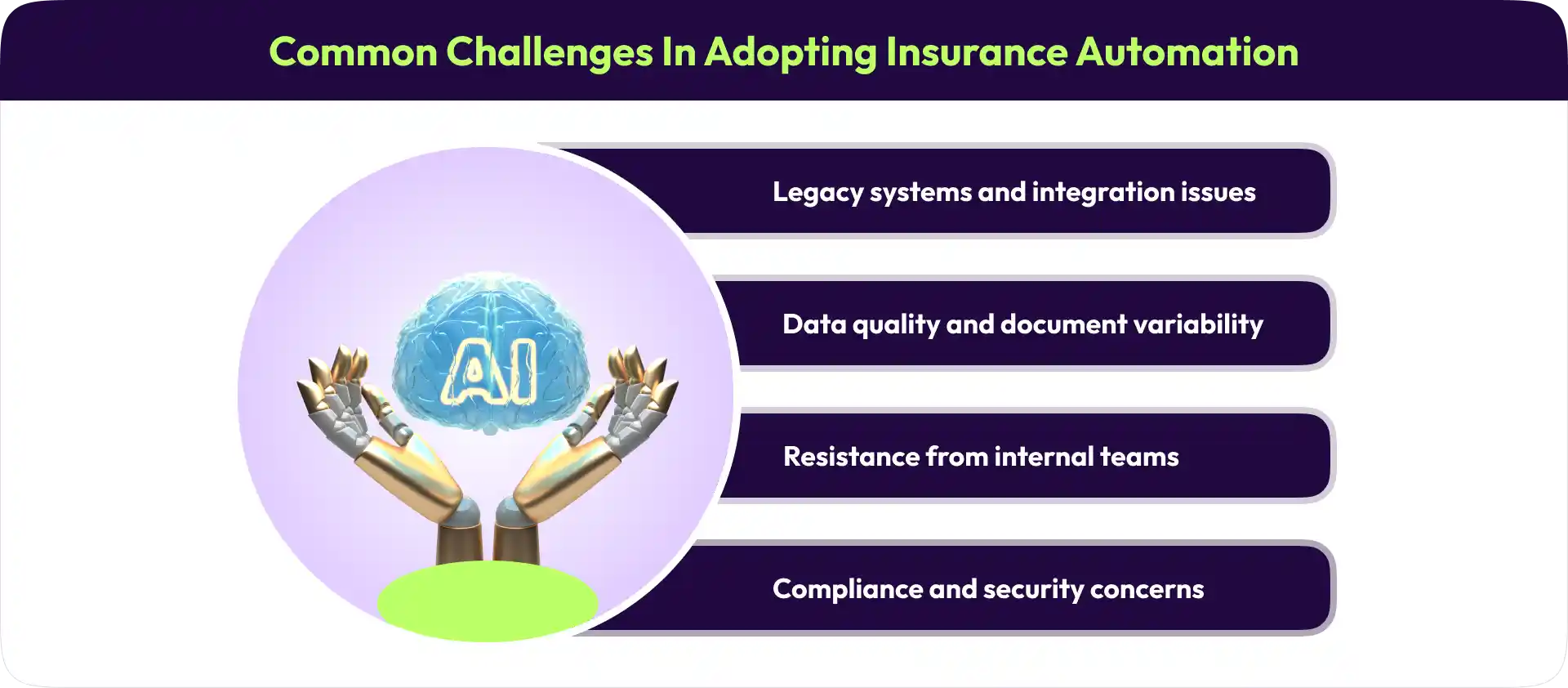
Common Challenges in Adopting Insurance Automation
Media library
Adopting automation is valuable, but it does come with real implementation challenges. The good news is that most of them can be handled step by step.
Legacy Systems and Integration Issues
Many insurers still rely on older systems that are not easy to connect. Modern automation platforms help by integrating through APIs, so companies can improve workflows without replacing everything at once.
Data Quality and Document Variability
Insurance data is often unstructured and inconsistent. AI models are increasingly better at handling varied document types, and well-designed workflows can improve data quality over time.
Resistance From Internal Teams
Teams may worry about change or about losing control over important processes. Starting with a smaller use case and showing clear results often makes adoption easier and builds internal trust.
Compliance and Security Concerns
Insurance operations involve sensitive information, so security and compliance matter at every step. Modern automation solutions are usually designed around industry standards, auditability, and controlled access.
What Makes Insurance Process Automation Effective and Scalable
Not every automation project produces strong results. For insurance process automation to work well over time, the system needs to support more than one isolated task.
The ability to handle unstructured data such as documents, emails, and forms
End-to-end workflow automation beyond just data extraction
Seamless integration with existing insurance systems
Real-time visibility and tracking for operational teams
Scalability as case volumes and operational complexity increase
Minimal manual dependency while still allowing human oversight where needed
When these elements come together, automation does more than optimize one process. It improves how insurance operations run as a whole.
How AI Automation Simplifies Complex Insurance Workflows
Insurance workflows often become complicated because multiple teams, systems, approvals, and dependencies are involved. AI automation helps simplify this complexity by connecting everything into one coordinated flow.
Unified workflow management across teams and systems
Reduced manual touchpoints that slow processes down
Better coordination through automatic task assignment
Improved visibility and real-time tracking for faster response
Scalability without adding unnecessary operational complexity
Compatibility with existing systems instead of requiring major replacement
In simple terms, AI automation reduces operational chaos and makes insurance workflows easier to manage at scale.
Final Thought
Insurance is clearly moving toward smarter and more efficient operations. Manual workflows are gradually being replaced by connected systems that can process information faster, reduce delays, and improve visibility across the business.
That is why insurance process automation is no longer optional for many insurers. It helps reduce operational costs, improves processing speed, and creates a better customer experience at every stage of the journey.
And this is only the beginning. As AI continues to improve, insurers will be able to handle more complexity with less effort. The companies that start earlier will be in a stronger position, not only operationally, but also in how they serve and retain customers.
About the author
Shravan Rajpurohit
Shravan Rajpurohit is the Co-Founder & CEO of The Intellify, a leading Custom Software Development company that empowers startups, product development teams, and Fortune 500 companies. With over 10 years of experience in marketing, sales, and customer success, Shravan has been driving digital innovation since 2018, leading a team of 50+ creative professionals. His mission is to bridge the gap between business ideas and reality through advanced tech solutions, aiming to make The Intellify a global leader. He focuses on delivering excellence, solving real-world problems, and pushing the limits of digital transformation.